

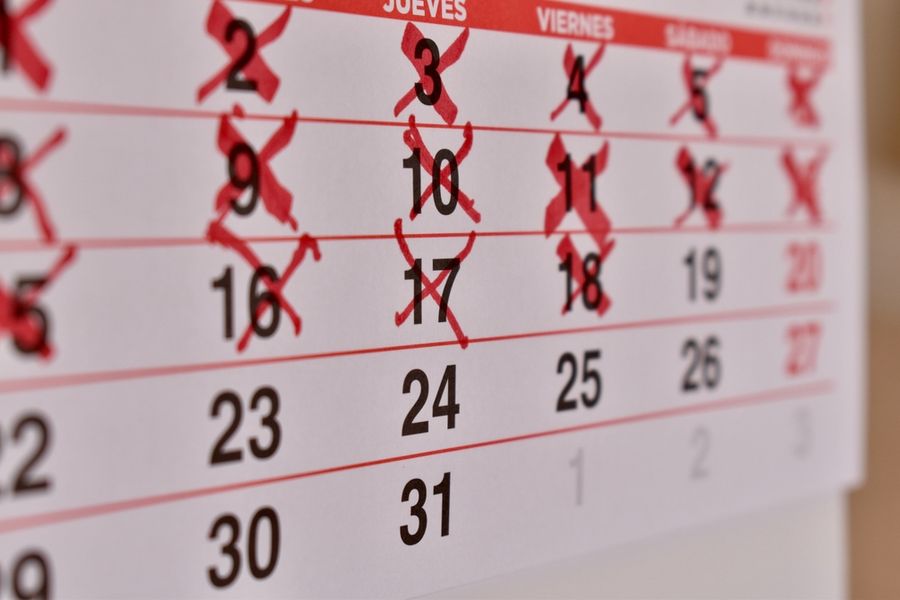
Building a skill often requires more than occasional bursts of enthusiasm. Writing, drawing, studying, exercising, or practicing an instrument can improve when the activity becomes something you return to consistently. The Seinfeld Calendar Method offers a remarkably simple way to encourage that repetition: complete a chosen activity, mark the day on a calendar, and try to keep the resulting chain intact. Its usefulness comes from making consistency visible and giving each day a clear objective.
How the Seinfeld Calendar Method Works
The technique is commonly associated with comedian Jerry Seinfeld through a story told by aspiring comedian Brad Isaac. According to Isaac, Seinfeld advised him to write jokes every day and mark each successful day with a large red X on a wall calendar. As the marks accumulated, they formed a visible chain that he would then try to maintain.
Despite its familiar name, the important part is not its celebrity association. The system itself is straightforward. Choose one practice, establish what counts as completing it, and record every successful day somewhere highly visible.
A traditional wall calendar works well, but a paper planner or digital streak tracker can perform the same basic function. What matters is being able to see your history of completed sessions at a glance.
Define a Practice You Can Actually Repeat
The method becomes less useful when the daily target is vague. “Become a better writer” cannot be checked off. “Write for 20 minutes” can. Similarly, “get fit” is difficult to measure, whereas “walk for 30 minutes” gives you a clear standard.
The target should also be realistic enough to repeat regularly. Committing to two hours of language study every evening may sound ambitious, but a smaller minimum could survive busy workdays, family obligations, travel, and low-energy periods.
This does not mean every session has to remain small. Your rule might require 15 minutes of piano practice, while leaving you free to continue for an hour when time and motivation allow. The minimum protects the routine; longer sessions can provide additional progress.
Connect the Practice to a Consistent Cue
A calendar records whether you practiced, but another step can make starting easier: decide when the practice will happen.
You might write after breakfast, stretch immediately after getting home from work, read before bed, or practice Spanish after lunch. Research on habit formation indicates that repeating a behavior in a consistent context can strengthen the association between a situation and the action performed there.
This approach removes one daily decision. Instead of repeatedly asking when you will find time to practice, a familiar event becomes your prompt to begin.
The cue does not have to be a precise clock time. Linking the activity to something that already happens reliably, such as morning coffee or finishing dinner, may work better when your daily schedule changes.
Let the Calendar Show Patterns, Not Just Streaks
The growing chain provides immediate evidence that you have been showing up. It can also reveal patterns that are harder to notice when you rely on memory.
Perhaps your practice regularly disappears on weekends. Maybe late-evening sessions are skipped more often than morning ones. A chain that repeatedly breaks after particularly demanding workdays could suggest that the activity needs a different time slot or a smaller minimum.
Treat the calendar as feedback rather than simply a scoreboard. After several weeks, review where gaps occur and adjust the routine accordingly.
You may also discover that the behavior itself needs refinement. Thirty minutes of unfocused guitar playing, for instance, might be less useful than 15 minutes devoted to one technique. Consistency creates opportunities to practice, but the quality and purpose of that practice still matter.
Do Not Let One Missed Day End the Experiment
The phrase “don’t break the chain” can make a missed day feel disproportionately important. Yet one empty square does not erase the work that came before it.
Research examining everyday habit formation found that occasionally missing an opportunity to perform a behavior did not seriously disrupt the overall habit-development process. That makes recovery more useful than perfection.
If you miss Tuesday, restart Wednesday rather than deciding the streak has failed. You can even adopt a secondary rule: never intentionally miss twice in a row.
Long-term consistency matters more than preserving a flawless calendar. The chain is supposed to encourage practice, not turn an unavoidable interruption into a reason to quit.
Turn Visible Consistency Into Lasting Practice
The Seinfeld Calendar Method strips practice down to a simple daily question: did you show up today? By choosing a specific action, connecting it to a reliable cue, marking completed sessions, and learning from gaps, you create a structure that makes repetition easier to maintain. The calendar cannot guarantee improvement on its own, but it can keep an important activity visible long enough for regular practice to become a familiar part of everyday life.