
Strength training does not always require repeatedly bending and straightening the knees, elbows, hips, or shoulders. Isometric exercises challenge muscles while the body holds a relatively fixed position, making them an intriguing option for people who want to build or maintain strength with less repetitive joint movement. From wall sits and planks to static bridges and arm holds, several exercises can target major muscle groups with little equipment and can be adapted to different ability levels.
Why Isometric Exercise Works Differently
During an isometric exercise, a muscle contracts without noticeably changing length, while the joint involved remains essentially stationary. This differs from exercises such as squats or biceps curls, where muscles shorten and lengthen as joints move repeatedly through a range of motion. Isometric training can help maintain or build strength and may also improve stabilization around joints and the core.
The tradeoff is that isometric strength gains tend to be most specific to the position being trained. Holding the knees at one angle, for example, does not develop strength equally throughout every possible knee position. For a well-rounded fitness program, static exercises are therefore often used alongside other forms of resistance and mobility training rather than replacing them entirely.
Wall Sits Target the Thighs and Hips
A wall sit is one of the simplest ways to challenge the lower body without repeatedly performing squats. Stand with your back against a wall, move your feet forward, and slide down until you reach a comfortable seated position. Hold the position while keeping your back supported by the wall.
The quadriceps, glutes, and other lower-body muscles remain under tension even though the knees and hips are not continually flexing and extending. Wall squats are among the commonly recommended introductory isometric exercises.
Beginners do not have to descend until their thighs are parallel with the floor. A higher position reduces the difficulty and can be a more manageable starting point. As strength improves, the hold can gradually become longer or the position more demanding.
Planks Build Static Core Strength
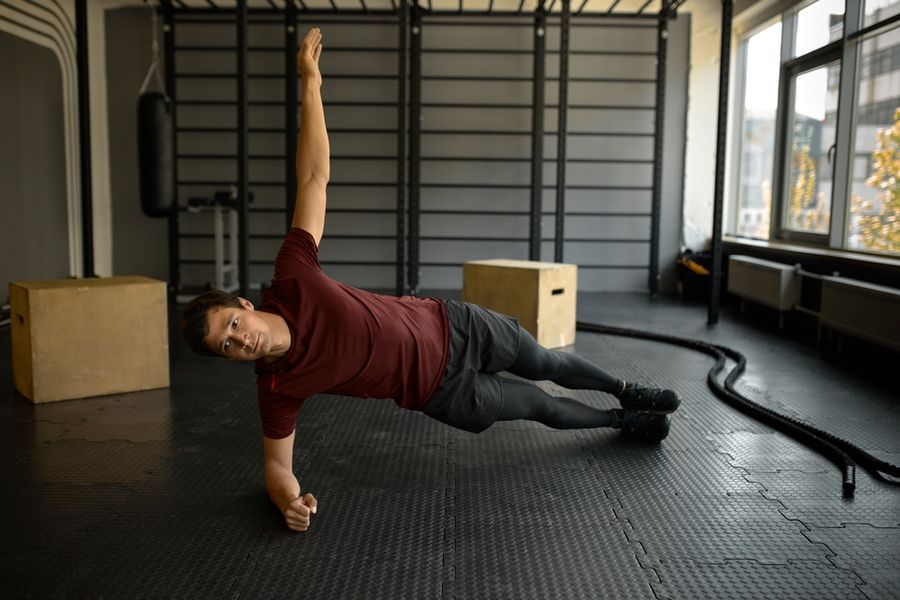
The plank is a familiar isometric exercise because the objective is not to perform repetitions but to resist movement.
Begin on the forearms and toes, or modify the exercise by supporting the knees on the floor. Keep the torso controlled rather than allowing the hips to sag or rise excessively. The abdominal muscles, back, shoulders, and other stabilizing muscles work together to maintain the position.
Planks are specifically identified as an isometric exercise for strengthening the core. A strong core contributes to stabilization during many everyday movements, from lifting groceries to getting out of a chair.
Quality is more important than holding a plank for as long as possible. End the hold when maintaining good positioning becomes difficult.
Glute Bridge Holds Strengthen the Back of the Body
A glute bridge can be turned into an isometric exercise by raising the hips and simply holding the top position rather than repeatedly lowering and lifting them.
Lie on your back with your knees bent and feet on the floor. Lift your hips until your torso and thighs form a comfortable line, tighten the gluteal muscles, and maintain the position. Glute bridges are another recommended example of isometric strength work.
The exercise primarily challenges the glutes while also recruiting muscles involved in stabilizing the hips and torso. It can be made easier by using a shorter hold or harder by extending the duration, provided good form can still be maintained.
Static Biceps Holds Train the Arms Without Repetitive Curls
The same principle can be applied to traditional weight exercises. Instead of repeatedly curling a dumbbell, bend the elbow to a chosen angle and hold the weight still.
This creates continuous tension in the biceps without repeatedly moving the elbow. An isometric biceps curl is among the static exercises recommended for beginners.
Choose resistance that can be controlled rather than starting with a heavy weight. Because strength improvements are angle-specific, holds can also be performed at different elbow positions on separate sets.
Start With Short, Controlled Holds
Long holds are not necessary for beginners. One clinical recommendation suggests beginning with holds of roughly three to 10 seconds and gradually working toward longer periods as tolerated.
Breathing normally is also important. Isometric exercise can temporarily increase blood pressure, so people with high blood pressure or cardiovascular concerns should discuss appropriate intensity with a healthcare professional before starting a demanding static-strength routine.
Likewise, reduced joint movement does not mean an exercise is automatically appropriate for every injury or painful joint. Persistent or significant pain warrants professional guidance rather than simply working around it.
Build Strength Without Chasing Repetitions
Isometric exercises provide a different way to challenge muscles: create tension, establish a stable position, and hold it. Wall sits can target the legs, planks challenge the core, bridge holds work the glutes, and static curls strengthen the arms without continuous joint motion.
They are not a complete substitute for movement-based training, but they can be a practical addition when repetitive motion is uncomfortable, equipment is limited, or a workout simply needs a different kind of strength challenge.