

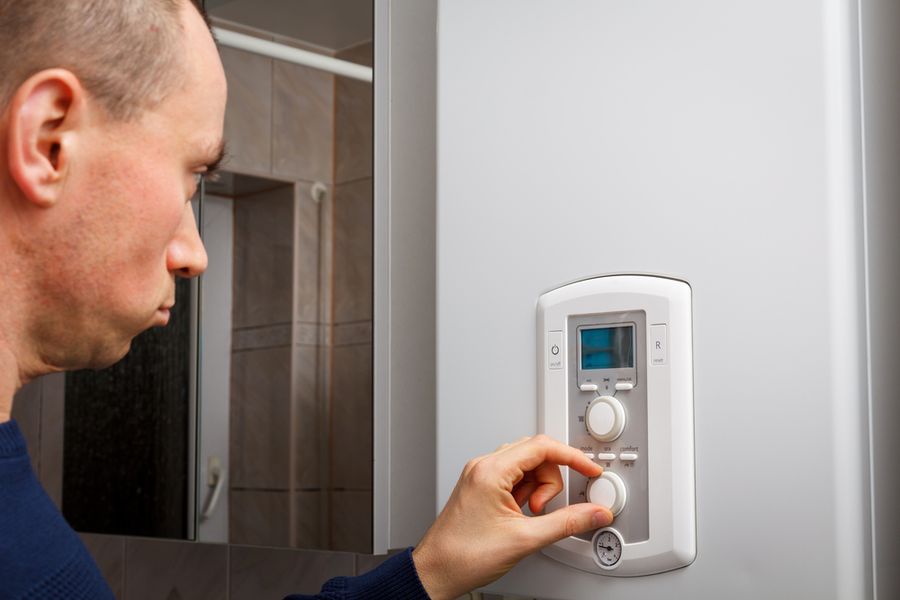
Heating the house and producing hot water normally involve two separate appliances, but combination systems can handle both jobs from one primary heat source. Depending on the design, a home might use a combi boiler that produces hot water on demand or a boiler connected to an indirect storage tank. Modern systems can save space and simplify mechanical rooms, but capacity, climate, existing distribution equipment, and household hot-water habits all determine whether combining the two functions makes practical sense.
Understand the Main Combination-System Options
A true combi boiler supplies heat for the home while also producing domestic hot water through a separate heat exchanger. When someone opens a hot-water faucet, the unit heats incoming water on demand rather than relying on a conventional storage water heater. Combination boilers can serve hydronic baseboards, radiators, radiant floors, or, in some configurations, a hot-water coil inside a forced-air system.
Another option pairs a boiler with an indirect water heater. Instead of heating household water directly, the boiler works with a heat exchanger in a separate storage tank, allowing heated water to be stored for later use.
Space Savings Can Be a Major Advantage
One of the clearest attractions of a combi boiler is physical consolidation. A wall-mounted unit can replace both a conventional boiler and a separate tank-style water heater, potentially freeing valuable basement, utility-room, or closet space. Eliminating a storage tank also avoids the standby heat losses associated with keeping a large volume of water hot continuously.
Combining functions can also mean fewer combustion appliances and fewer separate venting systems. A U.S. Department of Energy demonstration home, for example, uses one high-efficiency gas combination boiler for domestic hot water as well as radiant and forced-air heating. The actual savings depend on the equipment being replaced, however, so consolidation alone does not guarantee lower energy bills.
Hot-Water Demand Can Be the Deciding Factor
On-demand combi systems need enough capacity to heat water at the rate a household uses it. A single shower may be straightforward, but simultaneous showers, faucets, dishwashers, and washing machines can create a much larger peak demand. Tankless equipment should therefore be sized according to both required temperature rise and the maximum hot-water flow expected at one time.
This issue becomes especially important in larger households or homes with multiple bathrooms. Cold incoming water in northern climates also requires a greater temperature increase, which can reduce the amount of hot water an on-demand unit can provide at once. Families with frequent simultaneous hot-water use may prefer a boiler paired with an indirect storage tank rather than a completely tankless combi design.
Efficiency Depends on Proper Sizing
A high-efficiency combination boiler can perform both tasks efficiently, but buying the largest available unit is not necessarily the answer. Oversized heating equipment can cycle on and off too frequently, reducing efficiency and potentially affecting comfort and equipment life. Residential heating equipment should be selected according to the home’s calculated heating load rather than rules of thumb.
That creates an important design challenge with combi systems: the capacity needed to satisfy a large burst of domestic hot water can be much greater than the capacity needed to heat a well-insulated home. Modern modulating boilers can reduce their firing rate when demand is lower, but homeowners should still ask contractors to calculate both space-heating and domestic-hot-water requirements before selecting equipment.
Consider Your Existing Heating System
Combination boilers are particularly logical in homes that already distribute heat through hot-water baseboards, radiators, or radiant flooring. Replacing an aging boiler and separate water heater with one appropriately designed system can take advantage of plumbing that is already in place.
A house heated by a conventional forced-air furnace presents a different question. Some combination configurations can send boiler-heated water through a coil in an air handler, allowing a blower and duct system to distribute the heat, but that may require more extensive modifications. Homeowners replacing an existing system should compare the cost and complexity of conversion with simply installing new separate heating and water-heating equipment.
Remember the Single-Appliance Tradeoff
Consolidation has a downside: both major household functions depend on one appliance. If a combination boiler develops a problem, the home may temporarily lose both space heat and hot water rather than only one service. Maintenance and access to technicians familiar with the particular system therefore deserve consideration before installation.
Efficiency ratings also need to be compared carefully. For boilers, Annual Fuel Utilization Efficiency, or AFUE, indicates how efficiently fuel is converted into space heat over a typical year. Current ENERGY STAR-certified gas boilers have AFUE ratings of at least 90 percent. The complete system design, controls, distribution equipment, and installation quality still influence real-world performance.
Match the System to the Household
A combination heating and hot water system can be an excellent fit when space is limited, hydronic heating is already present, and household hot-water demand falls within the equipment’s capacity. It becomes less straightforward when several fixtures routinely need hot water simultaneously or converting the existing heating system requires major changes.
The best decision starts with separate calculations for the home’s heating load and peak hot-water demand, followed by a comparison of combi, indirect-storage, and separate-appliance options.